Climate-Responsive Desk Materials: Choose Right
By Kai Nguyen • 31st Mar
Climate-responsive desk materials and a weather-adaptive workspace are not marketing afterthoughts (they are the foundation of a setup that performs the same way in July as it does in January). I learned this the hard way after rebuilding my desk three times due to swelling particle board and warped edge-banding that threw off monitor arm geometry. Now I prioritize materials that don't expand, contract, or warp as humidity and temperature swing across seasons. For the 'why' behind this, see our desk material science guide. Your accessories depend on stable desk dimensions; your accessories depend on you choosing materials that hold their tolerances.
Why Climate Matters More Than Brand
When humidity swings from 35% to 75% relative humidity across seasons (a typical range in most climates), engineered wood moves.[2] Particle board and MDF, popular in budget standing desks, absorb moisture and swell. The adhesives inside can fail, and edge-banding separates. At first, you don't notice. Then your monitor arm clamp, torqued to spec, no longer sits flush. Your cable tray creeps forward 3 millimeters. Your keyboard height drifts. These are not failures; they are the desk breathing.
Bamboo behaves differently. With a Janka hardness rating of 1380 (harder than oak or walnut), bamboo resists moisture better than particle board.[2] It naturally resists warping and cracking because it's a single-structure grass, not layered plywood or glued fibers.[2] But marketing claims that bamboo is "immune" to climate stress are false. Adhesives used to join bamboo boards can fail if formaldehyde-heavy; opt for E0 or E1-rated boards to minimize off-gassing and maintain structural integrity.[2][3]
The Humidity Problem: Engineered Wood vs. Solid Core
Most standing desks use engineered wood with laminate or veneer finishes. The core is usually particleboard or MDF.[3] These materials are efficient (they waste less raw fiber than solid wood), but they are porous. A 20% swing in relative humidity can push particle board or MDF to expand 0.5 to 1.2% in thickness, depending on edge-sealing quality.[3] That's 0.05 to 0.12 inches on a 10-inch-deep desk. Your elbow hitting the wall at 9.5 inches is now hitting drywall at 9.37 inches. Not catastrophic, but a reason to measure hinge radii and collision zones with margin-to-spare from the start.
Engineered wood with sealed edges and low-VOC laminate or veneer reduces water ingress significantly.[3] CARB Phase 2 or GREENGUARD certification ensures formaldehyde control, which helps preserve adhesive longevity and structural form over years.[3] These materials are appropriate for most home offices and corporate fit-outs balancing cost, design, and low emissions.[3] The trade-off is that they still move, just more predictably and less than unsealed particle board.
Solid wood and bamboo move less, but they are costlier and less common in adjustable standing desks. Bamboo's carbon footprint is dramatically lower than hardwood (it absorbs up to 12% of atmospheric carbon dioxide and releases 35% more oxygen than an equivalent stand of trees).[2] If climate stability and environmental profile matter, bamboo is the stronger choice, provided edges are sealed and the adhesive profile is documented.
Temperature Swings and Finishing Surfaces
Temperature changes stress wood fiber less than humidity does, but finishes amplify problems. A powder-coated steel frame can contract and expand at a different rate than a laminated top, creating micro-stresses at the seam.[1] Over cycles (winter to summer, year after year), these stresses can crack veneer or cause delamination.
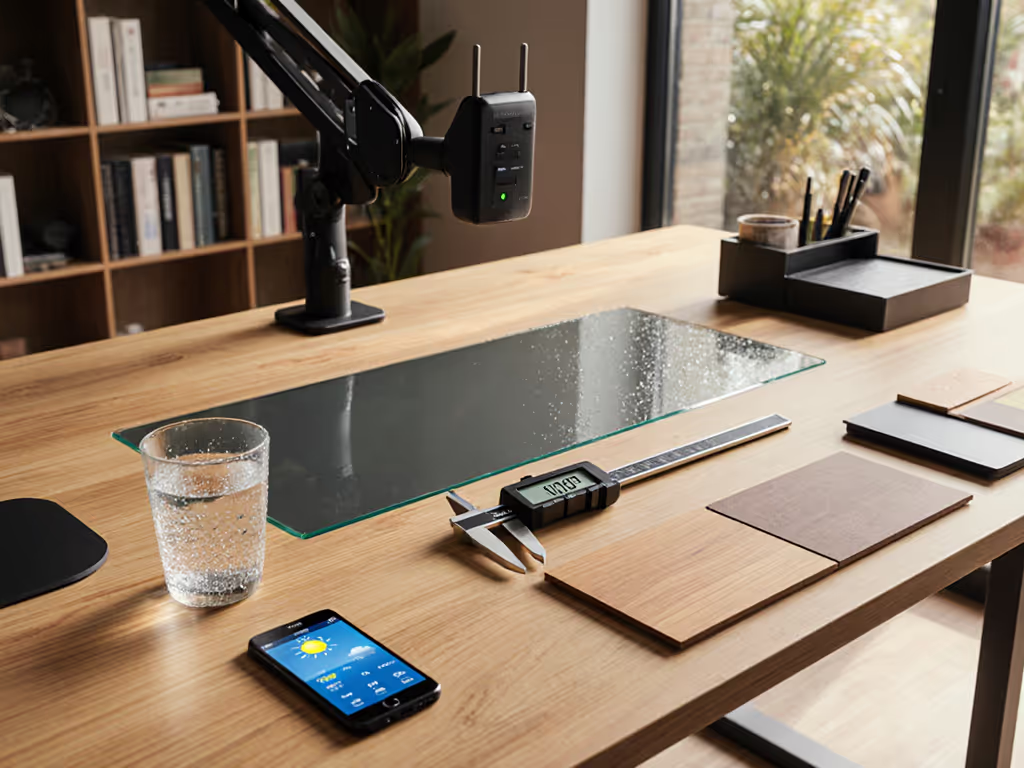
Linoleum, a surface material made from linseed oil, limestone, and cork dust, resists temperature and humidity shifts better than laminate.[1] It doesn't collect dust, a bonus for multi-user spaces or rooms with seasonal pollen swings.[1] It's durable and low-maintenance, though it's rarely the primary desk surface in modern setups (more common in healthcare or institutional furniture). For top surfaces, tempered glass excels at climate stability; it expands uniformly across temperature and humidity ranges and resists staining and scratches.[2] The trade-off is weight and fragility if the desk takes impacts. If you go this route, choose glass desk accessories with tested grip and surface protection to prevent slide and scratches.
MDF resists color drift from UV exposure better than some engineered wood options.[4] This is a smaller concern in indoor offices, but relevant if your workspace is near windows and receives seasonal light angle changes. Sealed, painted MDF holds its aesthetic better than unsealed particle board across humid and dry seasons. See our desk maintenance guide for cleaning and care routines that preserve seal integrity over time.
Moisture-Resistant Accessories and Seasonal Workspace Adjustments
Your desktop material is only half the equation. Match it with climate-resistant accessories that maintain performance in hot, cold, and humid conditions. Humidity-resistant desk accessories like cable trays, monitor arms, and clamps must also tolerate seasonal shifts without binding or losing clamping force. Powder-coated steel and aluminum expand less than plastic or rubber isolators.[1] If your monitor arm uses plastic hinges or rubber bushings, verify that the manufacturer has tested them across the humidity and temperature range in your climate.
One practical step: allow for 0.1-inch tolerance in clamp or tray depth during design. For seasonal comfort tweaks beyond materials, follow our climate-optimized desk accessories guide. If your wall is 10 inches behind the desk back, design for 9.9 inches of clearance at the hinge fully extended. This margin absorbs seasonal material shift without collision.
Temperature-stable desk materials like sintered stone (a non-porous engineered surface made from minerals) or mineral-core composite boards offer ultra-low movement across climate ranges.[10] These are expensive and uncommon in budget standing desks, but they eliminate the humidity variable entirely. They're ideal for setups that will not tolerate any accessory misalignment (precision studios, medical imaging labs, or high-stakes trading desks).
Comparative Analysis: Materials and Climate Profiles
| Material | Humidity Sensitivity | Temperature Sensitivity | Edge Seal Impact | Best Fit |
|---|---|---|---|---|
| Particle Board (unsealed) | Very High | Moderate | Critical | Budget builds (accept risk of drift) |
| Particle Board (sealed, E0/E1) | Moderate | Moderate | Improves resistance by 40 to 60% | Most affordable standing desks |
| Bamboo | Low to Moderate | Low | Lower impact (solid structure) | Eco-conscious users, climate stability priority |
| Engineered Wood + Low-VOC Veneer | Moderate | Moderate | Critical | Corporate and home office balance |
| Solid Wood | Low | Low | Less critical (dense fiber) | Premium builds, reparability priority |
| Tempered Glass (top surface) | Very Low | Very Low | N/A | Ultrawide or high-precision setups |
| Sintered Stone | Minimal | Minimal | N/A | Mission-critical, zero-drift applications |
What "Eco-Friendly Climate Materials" Really Means
Marketing often conflates sustainability with climate stability. They're independent. A fast-growing bamboo forest sequesters carbon, but adhesives in a poorly sealed bamboo desk can fail under humidity stress. A particle board core with an E0 formaldehyde rating is lower-emission but still swells if not edge-sealed.[2][3]
When evaluating eco-friendly climate materials, demand two documents: an environmental product declaration (EPD) showing sourcing and carbon footprint, and a technical data sheet with moisture expansion rates, formaldehyde ratings (CARB Phase 2, GREENGUARD), and edge-sealing specs. If a manufacturer can't provide these, the marketing is louder than the engineering.
Bamboo with FSC (Forest Stewardship Council) certification ensures responsible sourcing and minimal environmental footprint.[2] It's one of the few choices that stacks sustainability and climate stability simultaneously. But FSC certification doesn't guarantee formaldehyde control; check for E0 or E1 adhesive ratings independently.
Seasonal Workspace Adjustments and Measurement Discipline
The most practical step is not to fight seasonal drift (it's to design around it). Measure your desk depth, monitor arm reach, and wall clearance in both high-humidity and low-humidity seasons, if you live in a climate with extreme swings. CAD-informed sketches with tolerance ranges (e.g., 0.1-inch margin on all collision zones) will keep your setup stable as materials breathe.
Document your material specifications: particle board thickness and edge-sealing type, adhesive formaldehyde rating, and finishing surface. When you upgrade from single to dual monitors or add a cable management system, you'll know whether your desk can handle clamping loads and dimensional stability under new accessory weight.
Measure twice, clamp once. Your desk's climate response depends on knowing how it moves before you load it with $2,000 in monitors and arms.
Summary and Final Verdict
Climate-responsive desk materials are those that resist moisture absorption, maintain dimensional stability across humidity and temperature ranges, and are documented with technical data, not marketing bullet points. Bamboo with E0 adhesives, sealed engineered wood with CARB Phase 2 or GREENGUARD certification, and tempered glass or sintered stone surfaces offer predictable performance across seasons.
Particle board and MDF move; they're not "bad," but they demand design margin and re-verification after seasonal extremes. If you live in a climate with <40% humidity swings (rare in most inhabited zones), unsealed particle board is acceptable if budget is critical. Everywhere else, sealed particle board or bamboo is the practical minimum.
For remote and hybrid workers who layer accessories (monitor arms, cable trays, microphone booms), every millimeter of drift compounds. Collision mapping and tolerance ranges catch these problems before they force returns and rewiring. A desk that doesn't warp or swell frees you to iterate on ergonomics and cable paths, not chase dimensional mismatches.
Choose materials with published specifications, accept seasonal micro-movement as a design input, and build 0.1 to 0.2 inch margins into your accessory layout. Your workspace will scale, adapt, and endure across years and climate cycles without the frustration of tools that stop fitting.
Related Articles